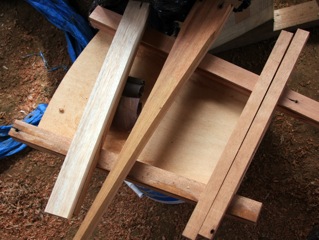
Interspersed with some other 'chores' in preparation for our return to the US, I managed to squeeze in a bit of time today on Shan Skailyn's spars. The rig is going to be a stub mast configuration. The stub mast is solid wood, and the other spars are bamboo. I've been hoping to get at least one coat of varnish on the spars before leaving them so the bugs don't eat them while we're away.
Today, I glued up the boom jaws (pix forthcoming - probably after boom jaws completed) and I also put some finishing touches on the luff spar. Since I want to be able to drop the whole thing at a moment's notice if things get hairy, I wanted some kind of quick releasing joint/mast step. I got this idea somewhere online... I think Gary D. mentioned it somewhere on his blog. Here you see the step assembly all together. Gary mentioned that this was the original universal joint that windsurfers used to use. The rope that passes through the step (located at deck level) will be tied off on a cleat (or maybe even a cam cleat for quicker release potential). Then the other side of the rope will have a loop tied in it, both to keep it from pulling through the mast base and also to secure the boom downhaul to. In this setup the mast base pivots freely in it's little socket joint / step. The luff spar is held upright by a halyard running through the top of the stub mast.
Today, besides gluing up the boom jaws, I applied the fiberglass wraps around the ends of the luff spar to help prevent splitting. I also had to doctor up a split about four fifths of the way up. I think it must have split when it was originally cut and fell. The split was there when my friend brought it up. This was such a nice piece of bamboo compared to the others I had available to me that I decided to take a chance and try to fix it. So today I pried the split open a bit, loaded it with thickened epoxy, even used a hypodermic needle to inject epoxy into the narrower parts. I then covered the split with a piece of fiberglass (see pic). I'm sure hoping this will hold up well for me. Anyone out there ever tried repairing a split in bamboo before? Any luck? I'd love to get your input. I'm wondering if I should also put several full wraps of fiberglass on there too, or was what I did enough?
Showing posts with label epoxy. Show all posts
Saturday, January 14, 2012
Bamboo mast / luff spar
Labels:
bamboo,
epoxy,
fiberglass,
spar,
universal joint
Wednesday, November 9, 2011
All done glassing
(Ah the joys of email from the bush over HF radio... sorry this post was screwed up again. Here's the text that belongs with the last two pix)
Not a whole lot of progress this last weekend. Just a few hours on Saturday then less than an hour Sunday afternoon. But it was enough time to finish glassing the bottom of the two end sections. Looking good! For some reason, I feel a major milestone has been passed now.
I used less epoxy on the end sections than I anticipated. One thing that made a big difference was that I used a different squeegee; one with a rubber piece on it. The last one I had used was just a soft plastic. I also tried the squeegee on the 2nd and 3rd coats of epoxy as well. Worked pretty nice for the flat bottom. Using thinner coats of epoxy got me a lot more print through of the weave (see picture), but it all scrapes down smooth without cutting into the glass, so it must be just enough. All in all, the total epoxy used for both end sections was exactly what it took to just do the middle section; five 5 oz dixie cups full.
Other than that I was able to take the scraper (just using a utility knife blade) to the middle section. All's nice and fair and smooth now! As I was scraping I realized that I may have put the 2nd and 3rd coats on a bit thick. I'll save the final sanding until just prior to painting.
Oh yeah, and I was able to finish getting everything ready to glue up my hollow box beam iakos. All the station blocks are screwed in place for clamping it into it's curved shape. All the wood is cut and just sitting, waiting to be glued.
Next step is getting my solid wood stub mast ready, including the mast step and collar. After that, I think I'll be ready to start prepping the hull for painting!
I used less epoxy on the end sections than I anticipated. One thing that made a big difference was that I used a different squeegee; one with a rubber piece on it. The last one I had used was just a soft plastic. I also tried the squeegee on the 2nd and 3rd coats of epoxy as well. Worked pretty nice for the flat bottom. Using thinner coats of epoxy got me a lot more print through of the weave (see picture), but it all scrapes down smooth without cutting into the glass, so it must be just enough. All in all, the total epoxy used for both end sections was exactly what it took to just do the middle section; five 5 oz dixie cups full.
Other than that I was able to take the scraper (just using a utility knife blade) to the middle section. All's nice and fair and smooth now! As I was scraping I realized that I may have put the 2nd and 3rd coats on a bit thick. I'll save the final sanding until just prior to painting.
Oh yeah, and I was able to finish getting everything ready to glue up my hollow box beam iakos. All the station blocks are screwed in place for clamping it into it's curved shape. All the wood is cut and just sitting, waiting to be glued.
Next step is getting my solid wood stub mast ready, including the mast step and collar. After that, I think I'll be ready to start prepping the hull for painting!
2011_11_5757.jpeg
2011_11_5754.jpeg
Tuesday, November 1, 2011
Beginner's experience with fiberglass
I finally deemed the hull ready to fiberglass this weekend. Being my first time ever working with fiberglass I've been nervous about it. I've gathered tons of online material about fiberglass for offline reading in the bush. I've asked a number of questions to glean from Gary D's many years of experience too. He, by far, has the most simplistic, least wasteful, least time consuming method I've come across so far. So I made that first step into the unknown on Saturday morning and fiberglassed the middle section.
I went with Gary's advice about the squeegee. Worked great. Poured the stuff on, starting the center of the hull and then squeegeed it around. Then I followed up with the brush. I'm overlapping the fiberglass 2" up the side of the hull. Squeegeeing didn't work too well on that part. Went with the brush. I also went with Gary's suggestion to try to get all three coats done in one full day, applying subsequent coats prior to the previous one fully curing. We're quite cool here in Mibu. So in order to get the temps to a point where things would cure fast enough to get all three coats on in a day, I started off in the morning by putting the hull out in the earliest sun light available, to warm it up a bit. I also warmed up the resin by putting the epoxy containers in warm water 1/2 hour before getting started. When ready, I moved the warmed hull indoors where the sun quickly warms things because of the corrugated tin roofing. I figured this whole process would have the hull actually cooling down rather than heating up as the resin cured, so as to not make bubbles from air expansion. OK, so done wetting by 9am. No bubbles to speak of and ready for second coat by 11am. Cloudy day, cooling off again around noon, so next round not ready till 2pm. There you have it... all three coats in one day.
All in all, the whole process worked like a charm. This morning, I'm seeing a very clear lay up where all the detail of the wood is visible. Not that clarity matters since I'm painting over it, but hey, it's nice to know I can do it in case I ever want to build another boat someday. However, I can see the cloth on close inspection (see pic). Yet the detail of the wood is nicely seen.
OK, let's talk quantities here; For the middle section (largest surface area to cover) I used a total of 5 dixie cups full of resin. I'm talking about the little 5 oz kids cups here. The initial wetting of the glass used 3. Actually I mixed up three and only used about 2.25 of them. The rest got 're-allocated' to strengthening joints, filling gaps and shaping out the very front end of the foredecks around the stem. Back to numbers... The subsequent coats of epoxy each took significantly less epoxy to fill the weave, each one taking exactly one 5 oz dixie cup full. All in all, glassing the bottom of the middle section of Shan Skailyn took only 25 oz of resin, or about .7 liters. Again, that number is skewed a bit because I made about 3/4 dixie cup too much for wetting out the cloth. So it really should have only taken about 21-22 oz total. I would imagine that each end section would be about two-thirds of the surface area of the middle section, thus using that much less resin on each one.
At this point, I'm a lot less worried that I'll have to buy more resin. I think I'll have enough to squeeze by, especially if I'm careful with the glassing of the end sections. I've been paying careful attention to measuring my resin up to this point, using large syringes to measure out my quantities. Once I got an idea of how much resin is needed for glue, I've been able to use it with very little waste. Being careful with the measurements like that is paying dividends now as it looks like I'll be able to make this thing using 3.75 liters of epoxy (about a gallon) per Gary's recommendations in his book.
I went with Gary's advice about the squeegee. Worked great. Poured the stuff on, starting the center of the hull and then squeegeed it around. Then I followed up with the brush. I'm overlapping the fiberglass 2" up the side of the hull. Squeegeeing didn't work too well on that part. Went with the brush. I also went with Gary's suggestion to try to get all three coats done in one full day, applying subsequent coats prior to the previous one fully curing. We're quite cool here in Mibu. So in order to get the temps to a point where things would cure fast enough to get all three coats on in a day, I started off in the morning by putting the hull out in the earliest sun light available, to warm it up a bit. I also warmed up the resin by putting the epoxy containers in warm water 1/2 hour before getting started. When ready, I moved the warmed hull indoors where the sun quickly warms things because of the corrugated tin roofing. I figured this whole process would have the hull actually cooling down rather than heating up as the resin cured, so as to not make bubbles from air expansion. OK, so done wetting by 9am. No bubbles to speak of and ready for second coat by 11am. Cloudy day, cooling off again around noon, so next round not ready till 2pm. There you have it... all three coats in one day.
All in all, the whole process worked like a charm. This morning, I'm seeing a very clear lay up where all the detail of the wood is visible. Not that clarity matters since I'm painting over it, but hey, it's nice to know I can do it in case I ever want to build another boat someday. However, I can see the cloth on close inspection (see pic). Yet the detail of the wood is nicely seen.
OK, let's talk quantities here; For the middle section (largest surface area to cover) I used a total of 5 dixie cups full of resin. I'm talking about the little 5 oz kids cups here. The initial wetting of the glass used 3. Actually I mixed up three and only used about 2.25 of them. The rest got 're-allocated' to strengthening joints, filling gaps and shaping out the very front end of the foredecks around the stem. Back to numbers... The subsequent coats of epoxy each took significantly less epoxy to fill the weave, each one taking exactly one 5 oz dixie cup full. All in all, glassing the bottom of the middle section of Shan Skailyn took only 25 oz of resin, or about .7 liters. Again, that number is skewed a bit because I made about 3/4 dixie cup too much for wetting out the cloth. So it really should have only taken about 21-22 oz total. I would imagine that each end section would be about two-thirds of the surface area of the middle section, thus using that much less resin on each one.
At this point, I'm a lot less worried that I'll have to buy more resin. I think I'll have enough to squeeze by, especially if I'm careful with the glassing of the end sections. I've been paying careful attention to measuring my resin up to this point, using large syringes to measure out my quantities. Once I got an idea of how much resin is needed for glue, I've been able to use it with very little waste. Being careful with the measurements like that is paying dividends now as it looks like I'll be able to make this thing using 3.75 liters of epoxy (about a gallon) per Gary's recommendations in his book.
Sunday, July 17, 2011
The Hull Story
So this weekend, I continued gluing more of the gunwales and chines onto the sides. Most people think of Papua New Guinea and think 'hot and humid'. But we're up high in the mountains, about 12 miles off the coast. Our weather here is cold, down in the low 50's in the morning and evening. Maybe tipping into the low 80's on nice days. Lately though, we've been in the 70's during the day. All that to say, I've learned that epoxy is going to take a LONG time to cure in these temps. It's taking about 24 hours to harden enough where I can barely push my fingernail into it. Then another day before it's fully hardened. Apparently gluing stuff together is going to take a while since I'm limited on clamps. I think once I'm done with the chines and gunwales though (only enough clamps to glue up 2 long pieces at a time) then things will probably pick up a bit. So far, I've managed to finish both sides for the middle section and I just finished gluing up the last of the chines and gunwales on one of the end pieces this morning. Usually only takes about 20-30 minutes of work to glue up two pieces, so maybe I can piece the rest of it together sometime during the week. Time will tell. I have a busy work week planned this week.
I cut all the pieces for the bulkhead perimeters. All that's left to cut is the lengths, angles and curves for the two station 1 perimeters (see pic). All the perimeters were cut from scrap pieces of tongue and groove flooring. It all worked out really well. I also managed to get station 3 (from Gary's Wa'apa plans) all glued up (see pic). I think for gluing my bulkhead perimeters, I'm going to take the easy way and use my brad nailer to get everything solid in place. Then I'll come back around with my bronze ring nails for the real support.
Also cut my stems. However, I realized that I put the 10 degree taper the wrong way; going narrower than the planned 3/4" width at the bottom; The wrong way! Debating whether or not I should recut those. Will that small thing make a big difference? It'll make the bow and stern narrower by a little more than 1/4". Maybe that'll be a good thing. Any thoughts? Any reason that that much of a difference in the stem width (at the bottom end) would cause serious problems? All I can think of is that the wood might split when I nail it. If anyone knows better, I'd appreciate some feedback here.
Tuesday, July 12, 2011
Response to comments
Hey DaveP, once again, thanks a ton for your input!
I'll have to try the coffee grinder on the sawdust. In order to keep the dust as fine as possible, I've been using stuff from my sander. It's not as fine as flour, but much more fine than what the saws produce.
So now, I'm wondering if I should do anything to 'fix' what I have already glued, or just leave it. I would think that I don't want to take chances with the chines or gunwales coming loose at any time. So far, I've only glued (and nailed with bronze ring nails) the 2 chines on the middle section sides, and one of the gunwales on one of the middle section sides. It's not too far down the road so as to be unsalvageable. I'm wondering how I could 'test' to see how things are going to hold. As far as solutions, I would imagine that the one least prone to cause irreparable damage while still doing the job well, will be to reinforce more with nails and then fillet those joints. I'm planning on fiberglassing the bottom with a 2-3" overlap, so that will help quite a bit too. Maybe some bonded screws toward the ends of the gunwale, closer to where all the stress will be from the iakos? Any other thoughts for making sure my boat doesn't fall apart on me out at sea?
Then obviously for the rest of my joints, I think I'll take your advice to make sure I get good adhesion. Good thing I asked!
I'll have to try the coffee grinder on the sawdust. In order to keep the dust as fine as possible, I've been using stuff from my sander. It's not as fine as flour, but much more fine than what the saws produce.
So now, I'm wondering if I should do anything to 'fix' what I have already glued, or just leave it. I would think that I don't want to take chances with the chines or gunwales coming loose at any time. So far, I've only glued (and nailed with bronze ring nails) the 2 chines on the middle section sides, and one of the gunwales on one of the middle section sides. It's not too far down the road so as to be unsalvageable. I'm wondering how I could 'test' to see how things are going to hold. As far as solutions, I would imagine that the one least prone to cause irreparable damage while still doing the job well, will be to reinforce more with nails and then fillet those joints. I'm planning on fiberglassing the bottom with a 2-3" overlap, so that will help quite a bit too. Maybe some bonded screws toward the ends of the gunwale, closer to where all the stress will be from the iakos? Any other thoughts for making sure my boat doesn't fall apart on me out at sea?
Then obviously for the rest of my joints, I think I'll take your advice to make sure I get good adhesion. Good thing I asked!
Monday, July 11, 2011
Epoxy thickener
I glued up a few of the chines and gunwales this weekend. Went alright. But I've been using sawdust from my sander to thicken the epoxy. I don't like the way it thickens it; not for gluing at least. I suspect the wood is 'drinking' up the epoxy and forcing me to use more than is necessary. I don't have any other 'thickener' available and wondering if anyone has any ideas or experience using other household materials to thicken epoxy? I was wondering if flour would work. No stores out here in the middle of the jungle! Thoughts? Anyone?
Sunday, June 5, 2011
Gearing up
Up until now, all I've been able to do so far is think and plan for the building of Shan Skailyn. Living in the bush for most of the year gives me very few opportunities to gather needed materials. I've pored over Gary Dierking's Outrigger Sailing Canoe book. I've got many of the details stored away in my head now as I've gone over and over how I want to build. I've got a list of items I'm going to need. I intended to prepare some materials from the lumber I currently have in Mibu (where we live in the bush) but diesel fuel was sent in mistakenly on our last helicopter run, rather than petrol. So no generator, no power, no power tools.
We're out in Madang now for a couple weeks. I've been shopping around in town mainly for marine plywood. Nobody has it. Agmark said they could order it from Lae. Placed the order. Then a couple days later said that even out of Lae they're not going to be able to get it. Now having to look at other options. Either what they call 'proof' ply or 'common' ply. The common stuff looks nice. The 6mm sheets are 5 ply. Both sides of the ply are nice and clean. But they say it will fall apart if exposed too much to water. Then their 'proof' ply is said to be for exterior applications with some exposure to moisture. Bad thing about this ply wood is that it's only 3 ply. And even worse, it's got a super thick middle ply with very thin outer ply. Any thoughts out there about what I should choose between these two?
Also bought some Akzo Nobel Epiglass epoxy resin. Whew! That was the expensive part of the boat. I'm looking for advice/thoughts regarding the possibility of thinning the epoxy (with acetone cause it's cheap) and then giving all the plywood a good once over so it soaks into the wood and dries, possibly making it stand up better to moisture in the future. Planning on glassing the bottom and then coating the rest of the hull with un-thinned epoxy before painting.
Got some 6oz fiberglass cloth, SS blocks, rope, etc on the way from the states in our co-workers' luggage. They'll be arriving in country on the 9th here.
Oh yeah. I found a large 24'x18' polytarp in town too. It's kind of a strange material, but seems just as strong as the recommended reinforced stuff. Interesting thing about this polytarp material is that it's not woven. It's all one solid piece. Doesn't stretch like the weaker, woven stuff. Seems about the same stretchiness as the reinforced stuff. Hoping it will work for my sail. It's got UV protection. There are no seams on it, just one big piece of tarp. So I'm thinking it ought to work well. But what do I know. I've never sailed before. Just going on comparing to the reinforced stuff.
So gearing up here... Sure would be good to get thoughts on anything here, especially that plywood and epoxy. Gotta make a final decision on that one here soon.
We're out in Madang now for a couple weeks. I've been shopping around in town mainly for marine plywood. Nobody has it. Agmark said they could order it from Lae. Placed the order. Then a couple days later said that even out of Lae they're not going to be able to get it. Now having to look at other options. Either what they call 'proof' ply or 'common' ply. The common stuff looks nice. The 6mm sheets are 5 ply. Both sides of the ply are nice and clean. But they say it will fall apart if exposed too much to water. Then their 'proof' ply is said to be for exterior applications with some exposure to moisture. Bad thing about this ply wood is that it's only 3 ply. And even worse, it's got a super thick middle ply with very thin outer ply. Any thoughts out there about what I should choose between these two?
Also bought some Akzo Nobel Epiglass epoxy resin. Whew! That was the expensive part of the boat. I'm looking for advice/thoughts regarding the possibility of thinning the epoxy (with acetone cause it's cheap) and then giving all the plywood a good once over so it soaks into the wood and dries, possibly making it stand up better to moisture in the future. Planning on glassing the bottom and then coating the rest of the hull with un-thinned epoxy before painting.
Got some 6oz fiberglass cloth, SS blocks, rope, etc on the way from the states in our co-workers' luggage. They'll be arriving in country on the 9th here.
Oh yeah. I found a large 24'x18' polytarp in town too. It's kind of a strange material, but seems just as strong as the recommended reinforced stuff. Interesting thing about this polytarp material is that it's not woven. It's all one solid piece. Doesn't stretch like the weaker, woven stuff. Seems about the same stretchiness as the reinforced stuff. Hoping it will work for my sail. It's got UV protection. There are no seams on it, just one big piece of tarp. So I'm thinking it ought to work well. But what do I know. I've never sailed before. Just going on comparing to the reinforced stuff.
So gearing up here... Sure would be good to get thoughts on anything here, especially that plywood and epoxy. Gotta make a final decision on that one here soon.
Subscribe to:
Posts (Atom)